
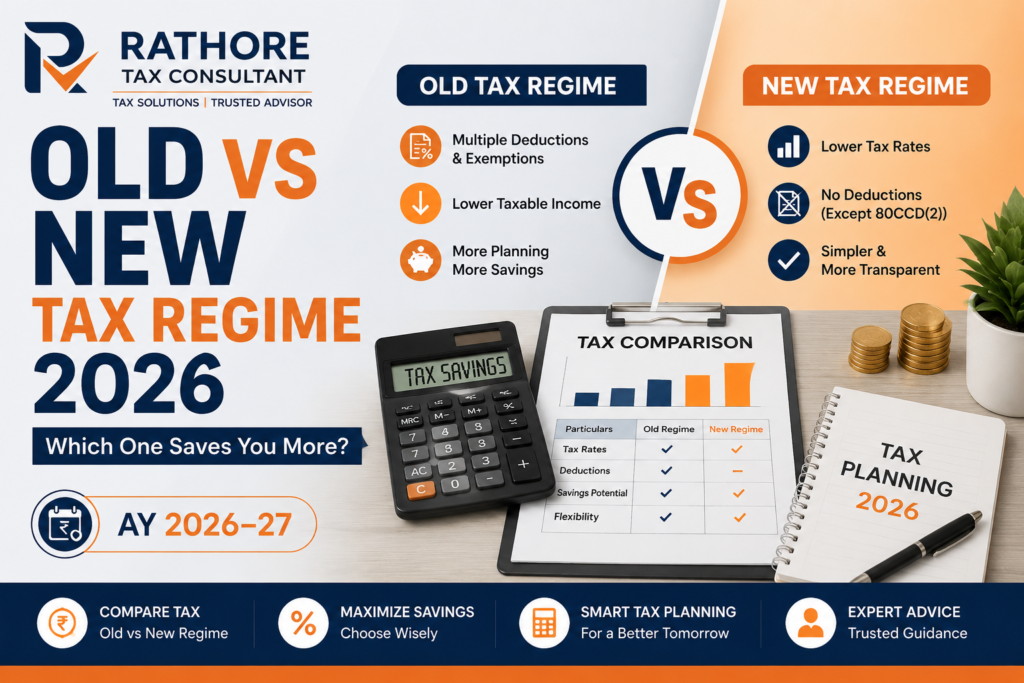
One of the biggest decisions you’ll make while filing your ITR for FY 2025-26 (AY 2026-27) is choosing between the old and new tax regime. Pick the wrong one, and you could end up paying thousands of rupees more in tax than necessary. This guide breaks down both regimes with real numbers, so you can make the right call.
New Tax Regime Slabs for FY 2025-26 (AY 2026-27)
The new tax regime is the default regime unless you actively opt for the old one. Here are the current slabs:
| Income Slab | Tax Rate |
|---|---|
| Up to ₹4,00,000 | Nil |
| ₹4,00,001 – ₹8,00,000 | 5% |
| ₹8,00,001 – ₹12,00,000 | 10% |
| ₹12,00,001 – ₹16,00,000 | 15% |
| ₹16,00,001 – ₹20,00,000 | 20% |
| ₹20,00,001 – ₹24,00,000 | 25% |
| Above ₹24,00,000 | 30% |
Under the new regime, salaried employees get a standard deduction of ₹75,000 (₹25,000 for pensioners). Combined with the Section 87A rebate, salaried individuals with taxable income up to ₹12,75,000 effectively pay zero tax.
Old Tax Regime Slabs for FY 2025-26
| Income Slab (below 60 years) | Tax Rate |
|---|---|
| Up to ₹2,50,000 | Nil |
| ₹2,50,001 – ₹5,00,000 | 5% |
| ₹5,00,001 – ₹10,00,000 | 20% |
| Above ₹10,00,000 | 30% |
Senior citizens (60-80 years) get a higher exemption limit of ₹3,00,000, and super senior citizens (above 80) get ₹5,00,000.
The old regime allows you to claim deductions such as:
- Section 80C (up to ₹1.5 lakh — PPF, ELSS, life insurance, etc.)
- Section 80D (health insurance premiums)
- HRA exemption
- Home loan interest under Section 24(b)
- Standard deduction of ₹50,000
So, Which Regime Should You Choose?
There’s no one-size-fits-all answer — it depends on how much you can claim in deductions. As a general rule of thumb:
- Few or no deductions? The new regime almost always works out cheaper.
- Deductions above ₹4-5 lakh (home loan interest + 80C + HRA + 80D combined)? The old regime may save you more.
- Higher income levels (₹25 lakh+) generally need deductions above ₹7-8 lakh for the old regime to beat the new one.
Here’s a simplified example: if your salary is ₹15 lakh and you don’t claim any major deductions, the new regime will almost certainly save you money. But if you’re paying a home loan EMI with significant interest, contributing to PPF, and paying HRA — the math can flip in favour of the old regime.
The only way to know for sure is to calculate both side by side using your actual numbers — this is exactly where a tax expert adds real value.
A Few Things to Keep in Mind
- Salaried employees can switch every year — you’re not locked into one regime.
- Business owners and professionals filing ITR-3/ITR-4 have restrictions on switching regimes frequently, so choose carefully.
- Inform your employer about your chosen regime so the correct TDS is deducted from your salary — this avoids a large tax outgo or refund at year-end.
- The new Income Tax Act, 2025 does not change anything for this year’s filing (FY 2025-26/AY 2026-27) — the old Income Tax Act, 1961 rules still apply.
Let Rathore Tax Consultant Do the Math for You
Choosing the wrong regime is one of the most common (and expensive) mistakes taxpayers make. At Rathore Tax Consultant, we calculate your tax liability under both regimes side by side using your actual salary structure and investments, and tell you exactly which one saves you more — no guesswork.
📞 Get a free regime comparison before you file: +91-9643372077 🌐 Or book your slot through our website rathoretaxconsultant.com.
FAQs
Q1. Which tax regime is better for salaried employees? If you have minimal deductions, the new regime is usually better due to lower rates and the ₹75,000 standard deduction. If your deductions (HRA, 80C, home loan interest, 80D) cross approximately ₹4-5 lakh, the old regime may work out cheaper.
Q2. Can I switch between old and new regime every year? Yes, salaried individuals without business income can switch regimes every financial year. Business owners and professionals have restrictions on how often they can switch.
Q3. What is the tax rebate limit under each regime? Under the new regime, taxable income up to ₹12 lakh (₹12.75 lakh for salaried, after standard deduction) is effectively tax-free due to the Section 87A rebate. Under the old regime, this limit is ₹5 lakh.
Q4. Do I need to inform my employer about my regime choice? Yes. Informing your employer ensures the correct TDS is deducted from your salary throughout the year, helping you avoid a large tax payment or refund at the time of filing.