

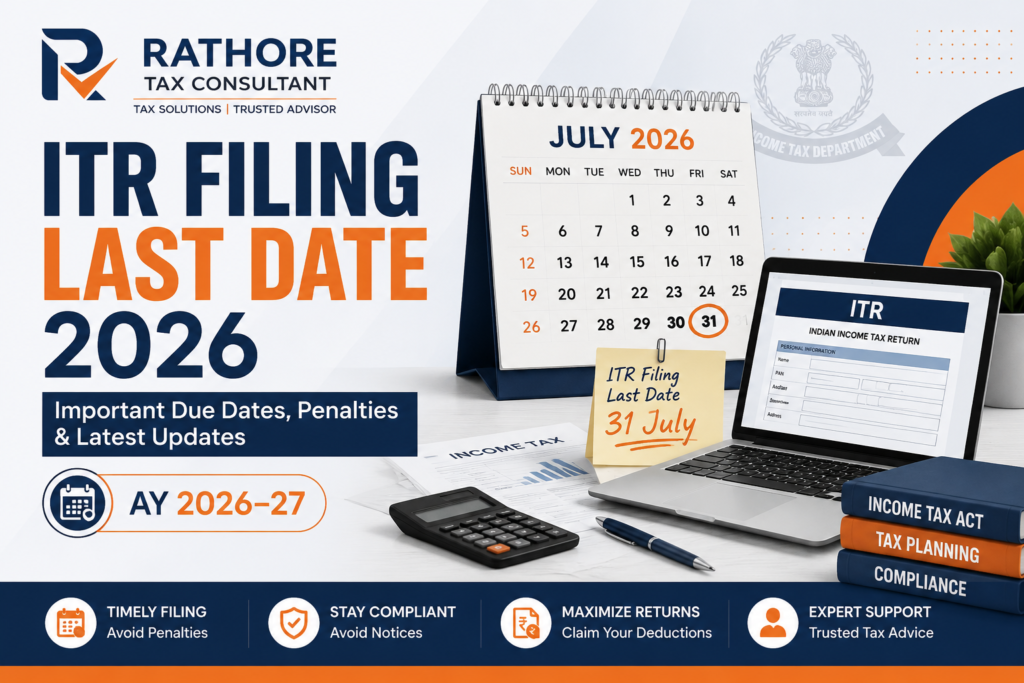
July is here, and if you haven’t filed your Income Tax Return yet, this guide is for you. Every year, thousands of taxpayers wait until the last moment and end up facing penalties, portal slowdowns, or filing errors. Here’s everything you need to know about the exact deadlines, penalty structure, and how to file stress-free.
ITR Filing Deadlines 2026 – Which Date Applies to You
For FY 2025-26 (AY 2026-27), deadlines are staggered based on taxpayer category:
| Taxpayer Category | ITR Form | Last Date |
|---|---|---|
| Salaried individuals, pensioners, capital gains | ITR-1, ITR-2 | 31st July 2026 |
| Freelancers, professionals, small businesses (non-audit) | ITR-3, ITR-4 | 31st August 2026 |
| Businesses requiring tax audit | ITR-3, ITR-4, ITR-5, ITR-6 | 31st October 2026 |
| Cases requiring transfer pricing reports | Form 3CEB applicable | 30th November 2026 |
Important: If you’re a salaried employee filing ITR-1 or ITR-2, your deadline is 31st July 2026 — the earliest of all categories this year. Don’t leave it for the last week.
What’s the Penalty for Late Filing?
If you miss the deadline, under Section 234F:
- ₹5,000 penalty if your total income exceeds ₹5 lakh
- ₹1,000 penalty if your total income is below ₹5 lakh
- Additionally, Section 234A charges 1% interest per month on any unpaid tax
Late filing also delays your refund, in case you’re expecting one.
Missed the Deadline? Here’s the Belated Return Option
If 31st July passes, you don’t need to panic — you can still file a belated return by 31st December 2026, though it comes with penalty and interest. That said, the best strategy is always to file within the original deadline.
Documents to Keep Ready Before Filing
- Form 16 (from your employer — salary and TDS details)
- Form 26AS / AIS (tax credit statement, downloadable from the income tax portal)
- Bank statements (savings interest, FD interest)
- Investment proofs (Section 80C, 80D deductions)
- Capital gains statement (if you’ve sold stocks, mutual funds, or property)
- Home loan interest certificate (if applicable)
Should You File It Yourself or Hire a CA?
Filing on the ITR portal looks simple, but small mistakes can get expensive:
- Choosing the wrong tax regime (old vs. new) — this can mean paying more tax than needed
- Ignoring AIS mismatches — this often triggers a notice
- Missing eligible deductions — leading to a smaller refund, or none at all
- Selecting the wrong ITR form — which can make your return defective
A single error can turn into a tax notice or penalty. If your income comes from multiple sources (salary + capital gains + rental income), or if this is your first time filing, professional guidance is worth it.
How Rathore Tax Consultant Can Help
We accurately and punctually file ITRs for 100+ clients in Delhi every year — salaried employees, freelancers, and small business owners alike. Our service includes:
- Correct ITR form selection
- Old vs. New tax regime comparison (which one saves you more)
- Maximum deduction claims
- AIS/26AS reconciliation
- Full support through e-verification
The deadline is approaching — don’t wait until the last moment.
📞 Call or WhatsApp us today for a free consultation: +91-9643372077 🌐 Or book your slot through our website rathoretaxconsultant.com.
FAQs
Q1. What is the ITR filing last date for 2026? For salaried individuals (ITR-1, ITR-2), the last date is 31st July 2026. For business/professional non-audit cases, it’s 31st August 2026.
Q2. What happens if I miss the deadline? You can still file a belated return until 31st December 2026, but you’ll incur a penalty of ₹1,000 to ₹5,000 plus interest.
Q3. Can I file my ITR myself? Yes, but if your income is complex (multiple sources, capital gains, business income), hiring a CA helps you avoid errors and notices.
Q4. What documents do I need to file my ITR? Form 16, Form 26AS/AIS, bank statements, investment proofs, and a capital gains statement (if applicable).